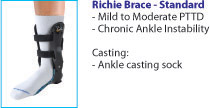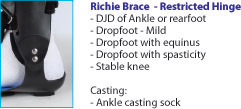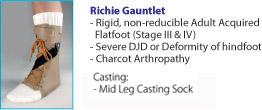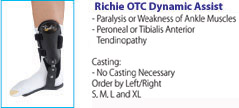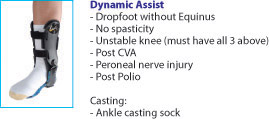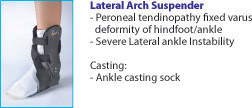
Clinical Indications
- Tibialis posterior dysfunction
- Lateral ankle instability
- Degenerative arthritis
- Mild drop foot
- Tarsal coalition
- Charcot foot deformity
- Peroneal tendinopathy
- Sinus tarsi syndrome
Suggested Reimbursement Coding*
- L1970
- AFO Plastic, molded to patient model with ankle joints
- L2820
- Soft interface, below knee section
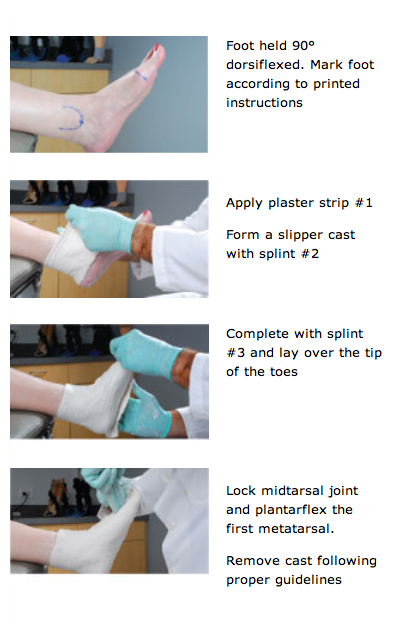
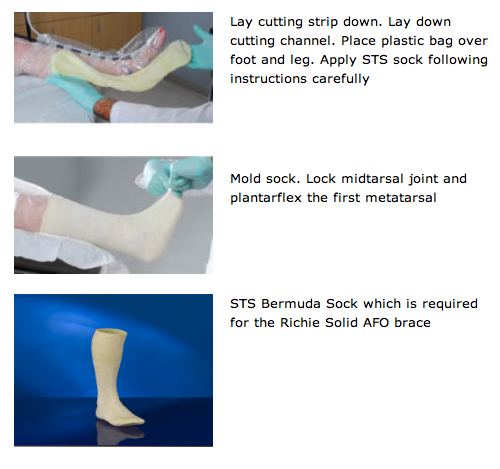
Casting Information
Please call 877 687 3338 |
 |
* The final responsibility for correct coding, within all established laws, rules, standards, and practices are the sole responsibility of the facility and practitioner submitting the claim.
“Great product, excellent customer support and all at a competitive price…all the ingredients of a winning support team for our St. John’s athletes and our Sports Medicine program. Thank you Footcare Express!"
Ron Linfonte ATC
Assistant AD-Sports Medicine
St. Johns University
Richie Brace Therapy: Problems and Solutions
By: Douglas Richie D.P.M.
The Richie Brace is a custom hinged ankle foot orthosis prescribed by practitioners for non-operative treatment of challenging lower extremity disorders. Utilized in the United States for over 6 years, the Richie Brace has been modified and continuously upgraded to improve comfort and efficacy. Despite the sophistication of the casting, cast corrections and fabrication processes utilized to produce the Richie Brace, the overall return rate for patient in-tolerance remains relatively low. Notwithstanding, there are several problems that can occur with Richie Brace prescription and fitting. Many of these problems are avoidable and will be reviewed in this document.
Problem #1: Malleolar Irritation
Rubbing of the orthotic footplate upright against the malleolus can occur when there is practitioner or lab error in placing the hinge too SUPERIOR to the tip of the malleolus. The hinge movements then occur against the bony fragile skin of the malleolus, rather than at or inferior to the tip of the malleolus where there is no bone pressure. Solution: Always mark the malleoli of the patient prior to casting; make sure the marks transfer to the negative cast. Check the malleolar pivot location of the brace against the patient at time of dispensing. Note any lab error and clarify before dispensing.
Rubbing of the medial malleolus can also occur in severe pronation disorders where there is significant medial displacement of the distal tibia associated with closed chain midtarsal joint pronation-subluxation. Sometimes, the off-weight bearing negative cast technique fails to capture the true medial displacement of the tibia (and talus), which ultimately occurs with weight bearing. Also, when there is poor control of the foot and the foot slides laterally off the orthotic footplate there is an accompanying medial shift of the tibia and talus. Solutions: Always perform a weight bearing assessment of the patient prior to casting. Determine if there is significant medial shift of the tibia. Note this on the special instructions of the Richie Brace orthotic prescription form. The lab can adjust the correction of the malleolar platforms to avoid brace rubbing. When a patient develops rubbing after brace dispensal, carefully evaluate if the foot is sliding or pronating laterally off the orthotic footplate. The arch may be too high on the footplate, causing the lateral slide. Or the footplate may be having poor conformity to the foot in a neutral position, loosing orthotic control. Check conformity of the heel, medial and lateral arches just as you would check accuracy of correction with any functional foot orthotic. Also, check the alignment of the footplate relative to the foot in the transverse plane. In severe transverse plane subluxation, the footplate of the Richie Brace should be positioned in a more abducted alignment to the limb supports (malleolar position). If not, the footplate will be abnormally positioned medially on the foot of the patient and poor conformity and control will result. If the lab is notified at time of original fabrication, the footplate can be positioned 15 to 30 degrees more abducted to the malleoli than standard required protocol. Spot heating and adjusting the upright portion of the ORTHOTIC FOOTPLATE can many times solve the medial malleolar rub. The heat should be focused on the segment just BELOW the medial ankle rivot. When the plastic becomes pliable, push the medial LIMB UPRIGHT downward, in a slight medial direction, forcing a slight bend in the orthotic plate medial upright. Hold for approximately 1 minute and then check to see if there has been adequate bending of the medial hinge section away from the patients medial malleoli. If attempts at spot heating fail, the brace should be returned to the lab with instructions to expand the ankle width of the brace or correct any deficiencies in the footplate control. Adding additional padding to the malleolar portion of the limb uprights does not usually solve irritation problems---this only increases the pressure against the malleoli. Finally, loss of pronation control can many times be solved by proper footwear prescription. Motion-control running shoes with medial posted midsoles and rigid shanks are recommended.
Problem #2: Talo-Navicular Irritation
The same factors causing medial malleolar rub can sometimes cause talo-navicular rub: excessive mid-tarsal joint subluxation, poor control of foot pronation, and poor conformity of the orthotic footplate. The subluxation of the talo-navicular joint is in a plantar-medial direction, usually due to loss of integrity of the spring ligament complex and/or attenuation of the posterior tibial tendon. Solution: A weight bearing assessment can determine if accommodation or a sweet spot should be ordered on the prescription form. If so, the negative cast should be marked ( by marking the patients talo-navicular joint) at the area of anticipated irritation. If the brace has already been dispensed, spot heating or accommodative padding under the topcover can be attempted in the office. Occasionally, grinding of the orthotic footplate away from the irritation can be attempted, however, this sometimes results in loss of control of this key area of the foot. A helpful maneuver to improve tibial control, and minimize talo-navicular subluxation involves instructing the patient to externally rotate the tibia while tightening the front upright straps. This positions the rearfoot complex in a slightly supinated position and may enhance control of the brace. In general, spot heating focused at the direct spot of irritation, plantar on the footplate, will allow pushing out a dimple large enough to solve the irritation immediately in the office, without having to return the brace to the lab.
Problem #3: Strap Irritation on the Leg
Large girth lower legs may be irritated by the limb upright straps. This is avoidable by anticipating this problem ahead of time and ordering the special Velcro padded protectors that can be applied to the Richie Brace at the lab, during fabrication. After dispensal, these pads can be applied to the Velcro straps by the practitioner in the office. The lab can provide these pads to the practitioner upon request.
The newest Richie Brace design has a wider posterior strap placed inferior to the calf to avoid irritation. Thus, posterior leg rubbing, previously the most common site, has now been minimized.
Problem #4: Arch Too High
A general arch height intolerance can be attributed to impression casting error by the practitioner. In the case of the Adult Acquired Flatfoot, there will be significant adaptation of the forefoot in an inverted alignment due to the severe valgus attitude of the rearfoot. This forefoot deformity, also known as suppinatus or acquired forefoot varus, must be reduced in the impression casting process. This is accomplished by fully loading the midtarsal joint in a locked, pronated position while pushing down gently on the dorsal surface of the first metatarsal during the impression casting procedure. Otherwise, a positional forefoot varus will be captured in the cast, which will then be intrinsically balanced by the fabrication laboratory. The footplate will thus position the forefoot inverted by pushing up the medial column of the foot. Excessive arch pressure will be reported by the patient. Any casting procedure that fails to fully load the midtarsal joint in a locked, pronated position can also capture a false forefoot varus that leads to the same footplate intolerance. Solution: Arch irritation should be addressed by spot heating and lowering in the office. Re-casting with careful correction of suppinatus may be necessary.
Problem 5: Foot Too Inverted in Brace
Occasionally, when there is a high degree of lower limb varum, the Richie Brace will orient the foot to the leg and cause an uncompensated varus of the rearfoot. Solution: In cases of Tibial Varum over 6 degrees, please indicate on the prescription form and the lab will orient the limb uprights to the exact degree of tibial varum measured.
Problem 6: Foot Too Pronated in Brace
If pronation control is not achieved a number of factors need consideration. Most of these were mentioned above in #1 and #2. First, assure that the footwear is appropriate with shank stability and firm heel counter. Poor conformity of the foot orthotic footplate against the patients foot can indicate a casting or fabrication error. In the office, additional pronation control with the Richie Brace can be obtained by adding a Korex medial post at the distal plantar margin of the footplate. Also, a 1/8th inch Korex wedge (Kirby type) can be added to the medial plantar surface of the heel seat of the footplate.
Summary:
- Most of the problems causing a failure of successful treatment with the Richie Brace can be traced to the following areas:
- Impression Casting Error- proper positioning of the foot is critical
- Lack of Markings of Malleoli - this leads to improper hinge location
- Lab Error Improper positive cast modifications can occur
- Prescription Error Clinical indications must be followed
- These problems can be avoided by careful review of the Richie Brace casting procedure requirements and the Richie Brace clinical indications.
Check out www.RichieBrace.com for more details